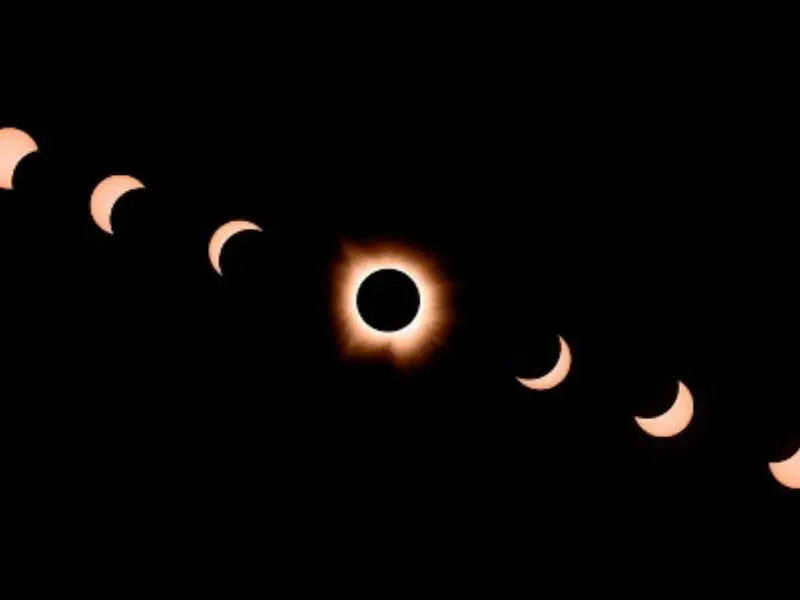
Six Minutes of Night at Noon: 2027 Eclipse to Stun Millions

A spectacular total solar eclipse will darken skies over Europe, North Africa, and the Middle East on August 2, 2027, offering millions a once-in-a-lifetime celestial experience. Known as the “Great North African Eclipse,” the event will feature up to 6 minutes and 23 seconds of total darkness, making it the longest land-visible eclipse between 1991 and 2114.
The eclipse will occur in the early to mid-afternoon, depending on location, with the full event lasting nearly three hours from first to final contact. Central Egypt, especially Luxor, will witness the longest totality, while cities from Cádiz in Spain to Jeddah in Saudi Arabia will also fall under the shadow.
Clear skies across North Africa, particularly in Libya and Egypt, promise ideal conditions for observers and scientists studying the Sun’s corona.
This unusually long eclipse results from three rare astronomical factors:
Earth will be at aphelion (its farthest point from the Sun), making the Sun appear smaller.
The Moon will be at perigee (its closest point to Earth), appearing larger.
The shadow path will track near the equator, where Earth’s rotation slows the shadow’s movement, extending totality.
The path of totality, stretching up to 275 kilometers wide, will cross Spain, Morocco, Algeria, Tunisia, Libya, Egypt, Sudan, Saudi Arabia, Yemen, and Somalia before moving over the Indian Ocean. Regions such as India, the Americas, and much of Asia will miss the show.
For scientists and skywatchers alike, the 2027 eclipse offers a rare chance to study solar phenomena and witness a natural wonder unmatched for nearly a century.



Iran Criticises UN Chief Over Response to US-Israel Attacks
Tehran: Iran has strongly criticised the United Nations Secretary-General António Guterres…

Iran Criticises UN Chief Over Response to US-Israel Attacks
Tehran: Iran has strongly criticised the United Nations Secretary-General António Guterres, accusing him of …