Scientific Sessions Highlight Ayurveda’s Role in Future Healthcare, Public Health and Addressing the Burden of Non-Communicable Diseases

Hon’ble Prime Minister’s message on the occasion was read out during the programme. In his message, Prime Minister Shri Narendra Modi said that Ayurveda’s journey from tradition to knowledge, evidence and innovation will contribute to securing the health and wellbeing of future generations. He highlighted that Ayurveda’s identity has expanded beyond India’s borders, with the AYUSH Visa facility enabling foreign nationals to seek treatment under AYUSH systems in India. Referring to the resolve of ‘Shakti ki Sadhna’, the Prime Minister said that India is moving steadily towards a Viksit Bharat and expressed confidence that institutions, experts and youth associated with Ayurveda will take this rich tradition to new heights and contribute to building a healthy, capable and strong nation.
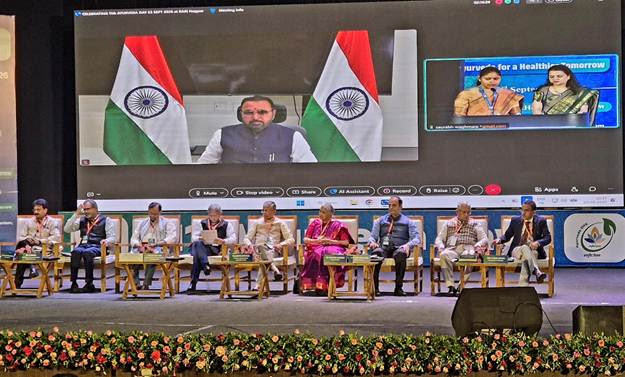
The celebration ceremony was virtually inaugurated by Union Minister of State (Independent Charge), Ministry of Ayush and Minister of State, Ministry of Health & Family Welfare, Shri Prataprao Jadhav in the presence of Secretary, Ministry of Ayush, Vaidya Rajesh Kotecha; Director General, Central Council for Research in Ayurvedic Sciences (CCRAS), Prof. (Vaidya) Rabinarayan Acharya, and other dignitaries.
Addressing the celebration, Union Minister Shri Prataprao Jadhav described Ayurveda as a key part of India’s health vision, saying, “स्वास्थ्य का पहला केंद्र अस्पताल नहीं, हमारा घर है। स्वास्थ्य का पहला आधार दवा नहीं, हमारी जीवनशैली है।” Citing the principle “स्वस्थस्य स्वास्थ्य रक्षणम्, आतुरस्य विकार प्रशमनम्”, he said Ayurveda prioritises preserving health alongside treatment, an approach he called increasingly relevant amid rising lifestyle-related health concerns.
Shri Prataprao Jadhav cited the WHO Global Traditional Medicine Centre in Jamnagar, ITRA Jamnagar’s recognition as an Institute of National Importance, and the inclusion of Ayurveda, Siddha and Unani in the WHO ICD-11 classification as key steps in internationalising traditional medicine. He called for connecting tradition with knowledge, evidence and innovation, adding that Ayurveda Day should extend beyond an annual observance to drive wider public engagement on healthy living.
Secretary, Ministry of Ayush, Vaidya Rajesh Kotecha, emphasised that the future of Ayurveda lies in connecting its knowledge tradition with scientific evidence, innovation and public health outcomes. He stressed the need to strengthen research, quality, safety and standardisation while promoting collaboration between Ayurveda and other healthcare systems. Highlighting key developments including the WHO Global Traditional Medicine Centre in Jamnagar, more than 43,000 research publications on the Ayush Research Portal, over 200 BIS standards and the Ayush Quality Mark, he said these efforts are aimed at making Ayush systems more scientific, evidence-based and globally relevant.
The programme witnessed the launch of Safety Dossiers on Gokshura (Tribulus terrestris) and Chandrasura (Lepidium sativum), Standard Treatment Guidelines (STGs) on Skin Disorders, and the first-ever Report on the “Ayush Services Sector”, prepared by the Research and Information System for Developing Countries (RIS), providing an assessment of the Ayush services sector.
The event also saw the launch of “From Traditional Wisdom to Global Leadership: Ayush Vision 2030”, the Status Report on Ayush-related Inventions in India, and the CCRAS–AGNI Assessment Scale Web Portal. The initiatives focus on strengthening research, documentation, innovation, clinical guidance and the systematic translation of Ayurveda knowledge into practice.
The programme also featured the presentation of Ayush Quality Mark Certification to four eligible industries by the Secretary, Ministry of Ayush, reflecting the emphasis on quality and standardisation within the Ayush sector.
The celebrations featured two scientific sessions on the evolving role of Ayurveda in healthcare and public health. The first session, “Shashwatam to Vishwas – Ayurveda for a Healthier Tomorrow and the Road to 2047”, featured Dr. G. Geethakrishnan Pillai, Unit Head, WHO Global Traditional Medicine Centre, Jamnagar, and focused on the future trajectory of Ayurveda, evidence generation and its role in the broader health vision towards 2047. The second session, “Integrating Therapies is needed to reduce NCD Burden by 2027”, featured Dr. Shiv Kumar Sarin, Director, Institute of Liver and Biliary Sciences (ILBS), New Delhi, and deliberated on the potential of integrated therapeutic approaches in addressing the growing burden of non-communicable diseases.
The scientific deliberations were followed by a summary presented by Prof. Sanjeev Sharma, Vice Chancellor, National Institute of Ayurveda, Jaipur. Prof. (Dr.) Unnat P. Pandit, Controller General of Patents, Designs & Trade Marks, also delivered remarks on the report on Ayush-related Inventions in India, while Dr. A. Raghu, Adviser (Ayurveda), Ministry of Ayush, spoke on the Standard Treatment Guidelines on Skin Disorders.
The event was graced by Shri Satyajit Paul, Senior Statistical Advisor, Ministry of Ayush; and Prof. Sachin Kumar Sharma, Director General, Research and Information System for Developing Countries (RIS) along with senior officials of the Ministry of Ayush, representatives of Ayush Councils and institutions.
A National Medicinal Plants Exhibition was also set up at the venue, featuring stalls by national institutions under the Ministry of Ayush and attracting considerable interest among visitors and participants.
The national celebration in Nagpur brought together practitioners, researchers, scientists, academics, institutions and other stakeholders from across the country, highlighting the growing focus on evidence, research, innovation, quality and holistic care in advancing Ayurveda. (PIB)

India Shares Experience in Digitisation and Modernisation of Land Records with Sri Lankan Delegation
23 SEP 2026 New Delhi :The Department of Land Resources (DoLR), Ministry of Rural Developm…
India Shares Experience in Digitisation and Modernisation of Land Records with Sri Lankan Delegation
23 SEP 2026 New Delhi :The Department of Land Resources (DoLR), Ministry of Rural …