Economic Survey 2025–26 Projects Robust Growth, Fiscal Stability and Structural Transformation Across Sectors

New Delhi, January 29: Union Minister for Finance and Corporate Affairs Nirmala Sitharaman on Wednesday tabled the Economic Survey 2025–26 in Parliament, projecting sustained economic momentum, fiscal stability and deep structural reforms across sectors, even as global uncertainties persist.
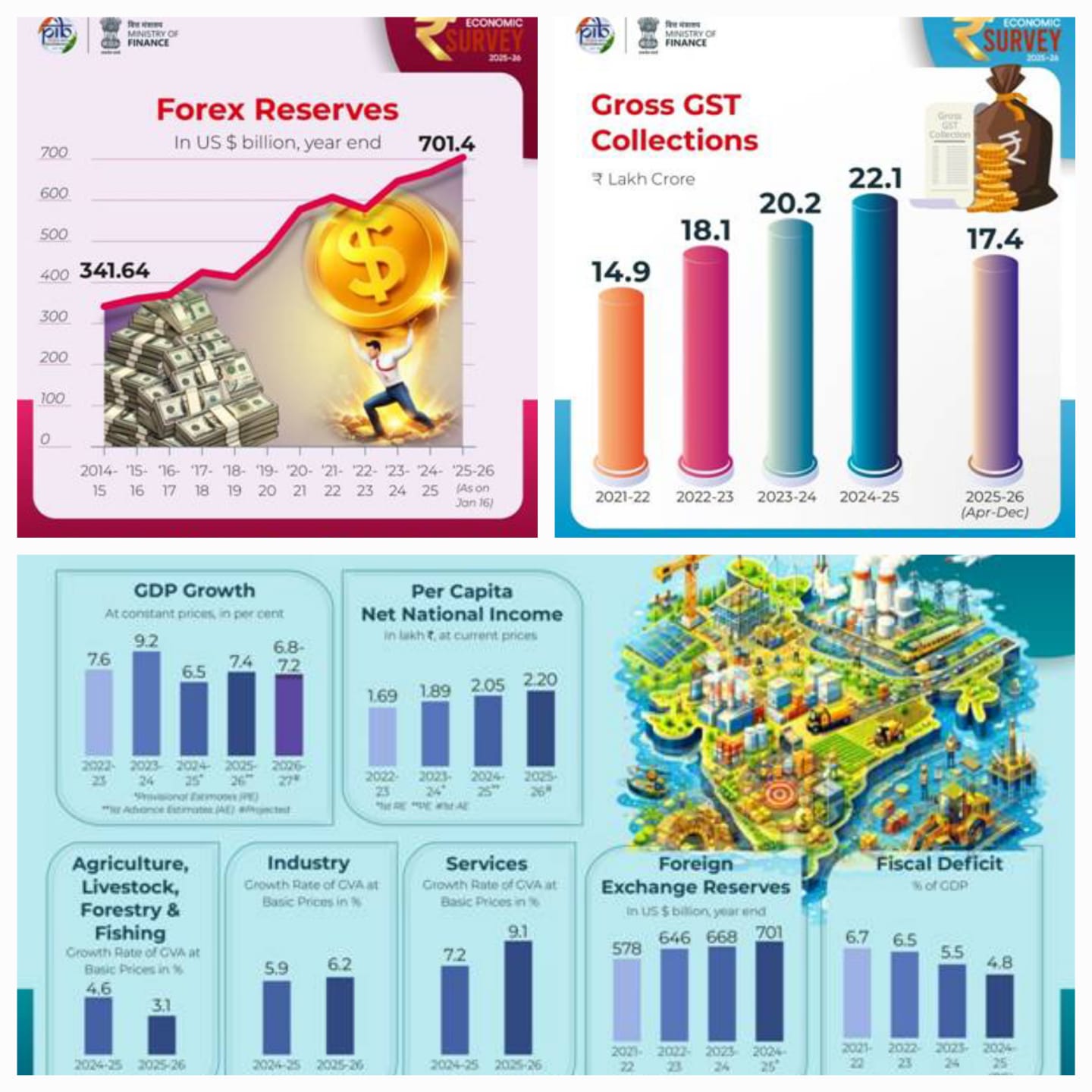
The Survey said the First Advance Estimates project real GDP growth at 7.4 per cent and Gross Value Added (GVA) growth at 7.3 per cent for FY26, reaffirming India’s position as the fastest-growing major economy for the fourth consecutive year. India’s potential growth is estimated at around 7 per cent, with real GDP growth for FY27 projected in the range of 6.8–7.2 per cent.
Despite a fragile global environment marked by geopolitical tensions, trade fragmentation and financial vulnerabilities, India’s economic performance remains resilient. Private Final Consumption Expenditure grew by 7.0 per cent in FY26, reaching 61.5 per cent of GDP, supported by low inflation, stable employment and rising real incomes. Gross Fixed Capital Formation rose by 7.8 per cent, with investment maintaining a steady share of 30 per cent of GDP.
Fiscal Developments:
The Survey highlighted credible fiscal consolidation as a key anchor of macroeconomic stability. The Centre’s revenue receipts strengthened to 9.2 per cent of GDP in FY25 (PA), driven by buoyant non-corporate tax collections. Direct tax compliance improved, with income tax returns rising from 6.9 crore in FY22 to 9.2 crore in FY25. Gross GST collections during April–December 2025 stood at ₹17.4 lakh crore, registering a year-on-year growth of 6.7 per cent.
Effective capital expenditure of the Centre increased to about 4 per cent of GDP in FY25, while States maintained capital spending at around 2.4 per cent of GDP through Special Assistance to States for Capital Expenditure. India reduced its general government debt-to-GDP ratio by 7.1 percentage points since 2020, even while sustaining high public investment. The government’s fiscal credibility resulted in three sovereign credit rating upgrades in 2025 by Morningstar DBRS, S&P Global Ratings and R&I.
Monetary and Financial Sector:
India’s banking sector recorded strong performance, with Gross NPAs declining to a multi-decadal low of 2.2 per cent and net NPAs to a record low of 0.5 per cent in September 2025. Credit growth rose to 14.5 per cent by December 2025. Financial inclusion continued to expand, with 55.02 crore PMJDY accounts opened, of which 36.63 crore are in rural and semi-urban areas. Under PMMY, loans worth over ₹36.18 lakh crore were disbursed across 55.45 crore accounts.
Capital markets expanded rapidly, with demat accounts crossing 21.6 crore and unique investors surpassing 12 crore, nearly a quarter of them women. India’s financial system received international validation through the IMF–World Bank Financial Sector Assessment Program 2025.
External Sector:
India’s share of global merchandise exports nearly doubled from 1 per cent in 2005 to 1.8 per cent in 2024, while its share of global services exports rose to 4.3 per cent. Total exports reached a record USD 825.3 billion in FY25. Services exports touched an all-time high of USD 387.6 billion, growing by 13.6 per cent. India remained the world’s largest recipient of remittances at USD 135.4 billion. Foreign exchange reserves rose to USD 701.4 billion, providing import cover of about 11 months.
Inflation:
India recorded its lowest inflation since the inception of the CPI series, with average headline inflation at 1.7 per cent during April–December 2025, among the sharpest declines among major emerging economies.
Agriculture and Rural Economy:
Foodgrain production reached a record 3,577.3 lakh metric tonnes in AY 2024–25. Livestock GVA rose nearly 195 per cent between FY15 and FY24, while fish production increased by over 140 per cent. Under PM-KISAN, over ₹4.09 lakh crore has been released to farmers. The SVAMITVA scheme completed drone surveys in 3.28 lakh villages, while 2.76 crore property cards were issued.
The Survey noted that the Viksit Bharat–GRAMG Act represents a comprehensive statutory overhaul of MGNREGS, aligning rural employment with the long-term vision of Viksit Bharat 2047.
Services, Industry and Investment:
Services’ share in GDP rose to 53.6 per cent, with India ranking as the world’s seventh-largest services exporter. Manufacturing GVA grew 7.72 per cent in Q1 and 9.13 per cent in Q2 FY26. PLI schemes attracted over ₹2 lakh crore in investment, generating production exceeding ₹18.7 lakh crore and over 12.6 lakh jobs. The India Semiconductor Mission approved 10 projects involving ₹1.60 lakh crore.
Infrastructure and Energy:
Government capital expenditure increased over fourfold since FY18. National highways expanded by nearly 60 per cent, high-speed corridors increased ten-fold, railway electrification reached 99.1 per cent and airports increased from 74 in 2014 to 164 in 2025. Renewable energy now constitutes nearly 50 per cent of installed capacity. DISCOMs recorded a historic turnaround with positive profits in FY25.
Education, Health and Employment:
India operates one of the world’s largest school systems, serving 24.69 crore students. The number of higher education institutions rose to 70,018, with 23 IITs, 21 IIMs and 20 AIIMS. Maternal mortality declined by 86 per cent since 1990, while infant mortality fell by over 37 per cent in the past decade.
Employment improved, with 56.2 crore people employed in Q2 FY26. The e-Shram portal registered over 31 crore unorganised workers, 54 per cent of them women. Vacancies on the National Career Service portal crossed 2.8 crore in FY25.
Outlook:
The Survey proposed a disciplined approach to ‘Swadeshi’, progressing from strategic resilience to strategic indispensability, strengthening competitiveness, reducing input costs and embedding India deeper into global value chains.
The Economic Survey concludes that India’s growth story is underpinned by macroeconomic stability, structural reforms, expanding infrastructure and inclusive development, positioning the country for sustained long-term growth.
(Source: PIB Delhi)

2 Overground Workers Arrested In J&K’s Baramulla; IEDs, Arms Seized
SRINAGAR, Oct 22: Security forces arrested two overground workers of terrorists and recove…

2 Overground Workers Arrested In J&K’s Baramulla; IEDs, Arms Seized
SRINAGAR, Oct 22: Security forces arrested two overground workers of terrorists and recovered arms …